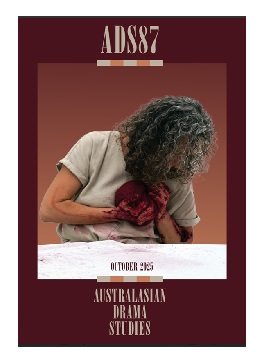
 Australasian Drama Studies Australasian Drama Studies
Issue 87| October 2025
- Issue 87 (Full Issue PDF)
- Contents
- EDITORIAL: CARE, DISCOMFORT AND PERFORMANCE
-
Careful Laughter and Queer Futurity in the Translating and Staging of Austere Rex Gamao’s Ambot sa Essay Kwoah – Erika M. Carreon, Austere Rex Gamao and Chloe Ho
This collaboratively written article highlights the care work at play in the authoring and staging of an agi’s experience by writer Austere Rex Gamao and Manila-based genderqueer collective Ang Mga Baklang Kanal (BKNL) respectively. It includes a first-hand discussion of discomfort experienced by Gamao in the process of textually translating the written essay from English, published in Cordite Poetry Review, to Sward-Hiligaynon, published in Art+Australia. Gamao’s discomfort, mirrored by the uncertainty of BKNL’s audience, is eased but not fully released in nervous laughter whenever performers and stage elements give permission to laugh through linguistic context, lighting and other stage and performative cues. These linguistic and dramatic translations of humour are discussed in relation to Glissant’s notion of opacity and as strategies of resisting queer erasure. We underline the laughter that results from this to open up the potential of experiencing queer time, a glimpse of queer futurity in the here and now.
Keywords
Queer time, queer futurity, discomfort, care
-
Devising, Discomfort and Working with the Unknown: Making a Show with Music and Theatre Students at a Regional University – Hannah Joyce Banks and Briony Luttrell In this article, we reflect on our experiences as practitioners and educators leading an annual devising collaboration between Music and Theatre at the University of the Sunshine Coast, that results in a new, one-hour production. We discuss the complexities of devising, in particular how we navigate the balance of wellbeing with encouraging students to work outside of their comfort zones in a devised theatre process full of uncertainty. In response to pedagogy and devising scholarship, and themes that emerged from our four case studies, we propose a new approach, the Creative Collaboration SeeSaw. Our aim in writing this article is to articulate our experiences of being director, musical director, and teachers, as we navigate with our cohorts the tensions between care, comfort, discomfort, learning and safety in a collaborative devising process full of doubt and the unknown.
Keywords
Devising, interdisciplinary collaboration, pedagogy, creative practice, discomfort
- Rebus Theatre’s Project Alchemy: On the Limits of Trauma-Informed Approaches in Applied Arts Projects – Vahri McKenzie and Robin Davidson Rebus Theatre’s Project Alchemy recruited fifteen regional artists from five Local Government Areas severely impacted by the Black Summer Bushfires. They produced five major artist-led community projects, including participatory events, public performances and exhibitions. Taking Project Alchemy as a starting point, this collaborative article engages critically with trauma-informed approaches in applied arts contexts, suggesting that the automatic adoption of this now-standardised health training should be re-evaluated in projects prioritising creative practice expertise. Interpreting our discoveries alongside recent and relevant literature, we found, first, that an uncritical over-reliance on health-oriented, trauma-informed frameworks can undermine such approaches’ best intentions. Second, further research is needed to understand the caring relations provided by creative practice itself in projects that adopt trauma-informed approaches in applied arts settings. Creative practice expertise is a distinct social and epistemological category that may be diminished in arts–health work because it lacks the financial resources of health and disaster recovery systems.
Keywords
Trauma-informed care and practice, arts–health, applied arts, creative practice expertise, arts-based evaluation
- Who Cares for the Carers? Verbatim Theatre and Hospital Workplace Culture – Paul Dwyer, Claire Hooker, Louise Nash, Karen Scott and David Williams There is ample evidence of the damage that healthcare practitioners sometimes do to one another in the too-frequently toxic workplaces to which they have become acculturated. Bullying, sexual harassment and discrimination are a common experience in hospitals, for doctors, nurses and allied health workers, and particularly for medical students, junior doctors and trainee specialists. Rates of clinical depression and anxiety, suicidal ideation and suicidal behaviour among this population are well above the norm. In this article, we offer a methodological commentary on the making of Grace Under Pressure, a verbatim theatre project that aimed to help make sense of some of the distress and discomfort experienced by healthcare workers and to support efforts to challenge the culture that produces such mistreatment. We do so in a spirit of critical reflexivity, acknowledging that verbatim theatre has the potential to harm as well as to repair. The questions we address here include: What are the risks against which the promise of verbatim theatre practice must be weighed? What tensions exist between verbatim theatre practice and qualitative methods of research as they are typically deployed by health researchers? How do interviewees/ research participants exercise agency within a process where theatre-makers are often pursuing their own dramaturgical logic
Keywords
Verbatim theatre, methodology, healthcare, hospitals, workplace culture
- Whakamana: Enhancing Dignity in Theatre with Precarious Communities – Punitive Welfare and the Deficit of Care in Un-Welfare State (2023) – Rand Hazou and Adrian Jackson This article interrogates various aspects of care, safety, risk and discomfort in the Hobson Street Theatre Company production Un-Welfare State (2023). The verbatim drama explored experiences of the welfare system in Aotearoa and highlighted the apparent deficit of ‘care’ within an increasingly ‘punitive’ welfare system.Using Un-Welfare State as a case study, this article suggests that within the discourse of applied theatre, where practice is arguably increasingly regulated by tighter ‘health and safety’ regimes, attention is increasingly skewed towards notions of care that often uncritically emphasise the need to create safety and minimise risk and discomfort. This article argues that theatre made in such conditions should focus on ‘enhancing dignity’ to bring some nuance to considerations of care in our practice. Drawing on the scholarship of the Dignity of Risk (DofR) from disability and aged care studies, we argue that the notion of dignity opens up potentially useful considerations for arts practitioners and scholars working in precarious settings. This approach acknowledges the value of risk in nurturing the dignity and inherent worth of community participants.In this article, we are interested in what happens when we centre ‘dignity’ within theatre practice, particularly when working in spaces and with communities where notions of ‘care’ and ‘safety’ are tenuous, and where potential for ‘risk’ and ‘discomfort’ is substantial. This article argues that focusing on dignity may be a useful approach to negotiate aspects of care, safety, risk and discomfort within applied theatre projects with precarious communities.
Keywords
Documentary theatre, risk, care, dignity, punitive welfare
- Discomfort, Access and Care in (Learning-)Disabled Theatre – Tony McCaffrey The article draws on twenty years of practical experience with Different Light Theatre to highlight issues of access intimacy and friction within the company in the encounter of performers with different disabilities. It shows how these difficulties emerge in collective theatre-making and become the material for performance. It locates these practices within the wider context of disability performance art that confronts audiences with their own vulnerability. Finally, it suggests how performance that incorporates pain and discomfort opens up personal and political possibilities, different modes of understanding and practising access and care, and a more diverse and disability-led experience of theatre.
Keywords
Learning disabled theatre, ethics of care, care aesthetics, access intimacy/ friction, dignity of risk
- Disrupting the ‘Double Empathy’ Problem: Creating Cultural Safety for Neurominorities in Performing Arts Education and Employment – Bree Hadley The arts industry in Australia currently demonstrates a commitment to diversity. d/Deaf, Disabled and/or Neurodivergent artists – particularly ‘invisibly’ disabled Neurodivergent artists – have not always felt foregrounded in this discourse. Policy and funding programmes have not equalised our education and employment outcomes. In a recent Psychology PhD, Christine Antonopoulos (2024) examines policy, stated intention and workplace practice, finding that – despite stated intentions – 80 per cent of Australians implicitly perceive Disabled people as cold, incompetent and childlike. In Autism studies, Damian Milton (2012) describes this as a ‘double empathy’ problem. Neurodivergent ways of communicating, collaborating and co-working can ‘discomfort’ Neurotypical workers. Masking to fit into Neurotypical workplaces, projects and processes can ‘discomfort’ Neurodivergent workers. This, theatre-maker Alexander Leggett (2023) says, is not a competence problem – it is a ‘translation’ problem. In this article, I draw on education, employment and arts research, including interviews with Australian artists, to consider strategies to bridge this gap in understanding, and create cultural safety for neurominorities in the performing arts.
Keywords
Performing arts education, performing arts employment, equity, access, neurodiversity, neuroinclusion, cultural safety
- Collaborative Care: Artistic Reflection on the Creation of Agiles, an AR Prototype for Creativity and Mobility – Sarah Neville, Eva Sifis, Alex DeGaris, Scott Coleman, Matthew J.W. Thomas and This article offers an artistic reflection on care within cross-disciplinary co-creation, focusing on the development of the Agiles Augmented Reality (AR) application during an artist residency at Assemblage: Centre for Creative Arts. Agiles AR is a digital performance prototype designed as an instrument of care for use in healthcare contexts, encouraging users to explore mobility and balance through creative movement. The co-creation process was underpinned by principles of collaborative care, ensuring the inclusion of participants with and without lived experience of acquired brain injury and disability. Reflections focus on the ethics of care required to navigate interdisciplinary collaboration, and on negotiating discomfort and ease within embodied practice. These insights emerge from within the specific challenges of academic research structures, artistic collaboration, and the embodied experiences of the creative team.
Keywords
Co-creation, care, Augmented Reality, mobility, creativity
- Embodied Healing: Scar, Touch and Poetic Witnessing in Performance Art – Tingyu Liu This article explores Marks, Skin and Silent Verbs, a participatory performance art project by Chinese artist Wang Xiyue, presented in Chengdu, China, 2024. Focusing on physical scars, this performance transforms the skin into a site of memory, trauma and healing. Drawing on Didier Anzieu’s concept of the Moi-Peau (Skin-Ego), this article examines how Wang uses intimate gestures, such as touch and temporary poetic tattooing, to reframe scars as symbols of resilience. Through embodied interaction, discomfort becomes a necessary prelude to healing, allowing participants to encounter and explore vulnerability as it emerges in the performance and to reclaim a sense of narrative agency. Participants’ responses reveal the profound emotional impact of the performance, highlighting its ability to foster empathy and empowerment. This article argues that Wang’s performance exemplifies how performance art can act as a relational and ethical practice, offering new possibilities for healing, recognition and the transformation of bodily memory into shared, poetic archives.
Keywords
Performance art, trauma, healing, embodied interaction, scar
- Relational Patterns in Performance Art Practices: A Dialogue Between Representative and Performative Care – Cinzia Cremona This article aims to activate a productive dialogue between different modalities of performance, participation and care. The first part of the text introduces the key concepts that inform and shape the research – care, participation and performative relationality are defined in the context of performance art practices. These concepts overlap and lean on each other to form a solid conceptual framework. Performative writing and affective ethnography methodologies complement these analytical tools with a structured first-person voice better suited to access affect.
The body of this text discusses the implications of these concepts and methods for care-focused performances. The meaningful examination of performative and representative care in action, and the concluding comments, are intended to serve as a provocation for productive conversations.
Keywords
Relationality, performativity, caring, performance, affective ethnography
- Performing Scenographies of Care: Finding Agency for Environmental Sustainability and Performance Design within Conventional Theatre Practices – Penny Challen, Paula Martins and Tanja Beer Practices of care are evident in theatre’s global shift towards environmental sustainability over the last decade. The ecological turn in the performing arts has seen a rise in efforts to reduce the environmental impacts of theatre production, including questioning the extractivist and unhealthy habits of theatre-making. Historically, an ‘at-all-costs’ approach where the ‘show must go on’, irrespective of the damage to the environment, or individuals involved, has been normalised. For many performance designers, the materially intensive customs of conventional theatre represent a disconnect between personal ecological values and practice, manifesting as a personal conflict with theatre creation systems. Explored through semi-structured interviews with five performance designers, this article examines how Australian practitioners are currently finding agency for ecologically sustainable practices within conventional theatre. Findings revealed the complexity and potential of care as a scenographic criterion, including the personal cost of and discomfort in the pursuit of ecological considerations in an industry yet to embrace sustainable ethics.
Keywords
Ecoscenography, performance design, care, sustainability, conventional theatre
- Reviews
- Contributors
|
|
